FEATURE · GTA HISTORY
From a city of pixels to a world that never switches off
Grand Theft Auto's history is about more than bigger maps. Each generation changed what players expected from a virtual city: freedom first, then identity, then credibility, and eventually a life that continues after the campaign ends.
In the original Grand Theft Auto, a road could become an improvised escape route with only a few cars and a top-down camera. In GTA V on PlayStation 5, that same idea sits alongside an enormous audiovisual production and an online experience supported with years of new content. Between those endpoints lies something more interesting than an increase in resolution: a change in the player's role, the scale of the business and the relationship between games and popular culture.
This feature covers seven games: Grand Theft Auto, GTA 2, GTA III, Vice City, San Andreas, GTA IV and GTA V, ending with its arrival on PS5. PlayStation provides the thread, but the series has always had a wider history. We do not attribute PC, Xbox or other platform sales to Sony's consoles, and we do not count rereleases as additional mainline games. London, Stories, Advance, Chinatown Wars and expansions sit outside this feature's scope, not outside GTA's history.
Our interpretation is that the series' greatest contribution was to turn the city into a promise: if something looked possible, players wanted to try it. That promise also created tensions. More freedom made the gap between the story's message and the rules' possibilities more visible. And as the persistent world became more valuable, entertainment design became increasingly entangled with the need to keep an audience coming back.
The scale of the commercial leap
Published milestones, in millions of units. Different dates and reporting periods; these are not PlayStation-only sales or a ranking of current lifetime totals.
Sales during fiscal 1998. This period figure is kept separate from cumulative bars; it is not the lifetime total. [1]
Linear scale from zero. For “more than” values, the bar shows the published threshold. Units do not equal unique players; older milestones do not automatically include later sales.
Grand Theft Auto: freedom before spectacle
The city starts to work as a system rather than just a backdrop.
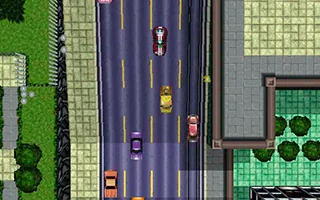
The original GTA belongs to the PlayStation era, although its launch spanned territories and platforms across 1997 and 1998. Its overhead view made the city a readable board of streets, traffic, pedestrians and vehicles whose ordinary purpose could change at any moment. No cinematic animation was needed to explain the attraction. Seeing a car and knowing it could become your next tool was enough.
The crucial decision was to let the journey compete with the objective. Driving to a job could turn into a chase that became more memorable than the mission itself. Here lies one of the series' foundations: the personal anecdote as a reward. Rules supplied a recognisable framework without guaranteeing a single sequence of events. The freedom was limited and sometimes awkward, yet it left productive space for the imagination. A simple street layout could support several stories because the player supplied part of the direction.
Its cultural provocation also came from who held control. Transgression was not merely something that happened in front of a spectator; it was an action the spectator could perform. That observation should be separated from causal claims about real-world violence: this is not a psychological study. For sales, Take-Two's annual report records more than 630,000 copies during its 1998 fiscal year. That is a period figure, not the game's complete worldwide lifetime total, so we do not plot it as an accumulated-sales bar alongside GTA V. [1]
GTA 2: a city that remembers
Reputation turns the map into a network of competing interests.
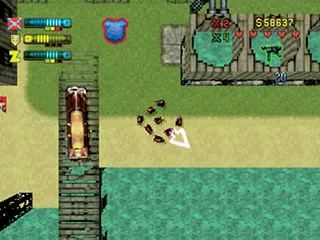
GTA 2 kept the overhead perspective while adding an idea that deserves more attention than its place between the original and GTA III: the city could respond to your allegiances. Working for one gang affected your relationship with others. Reputation gave continuing consequences to decisions that, in another action game, might have ended when the job was completed. Anywhere City's setting reinforced the sense of a territory shared by rival powers.
The change was not about making a building's facade more realistic. It was about connecting a place to its inhabitants and their conflicts. The same street could feel comfortable or dangerous depending on what you had done earlier. Seen from today, this provides a useful way to judge any open world: a map's surface area tells us less about its depth than the relationships that can change within it. The camera still kept the player at a distance, but the city was becoming less indifferent to their presence.
Take-Two reported more than one million GTA 2 copies shipped in the fiscal year ended October 31, 1999. That documents an important early commercial milestone, not a ceiling on later sales. It cannot establish that GTA 2 sold less than the original over their entire lifetimes. The more cautious industrial reading is that the formula could sustain a sequel, even though repeating its visual presentation would not be enough to explain the cultural leap that followed. [1]
GTA III: inhabiting the city changed the rules
The open world becomes an expectation for a major action game.
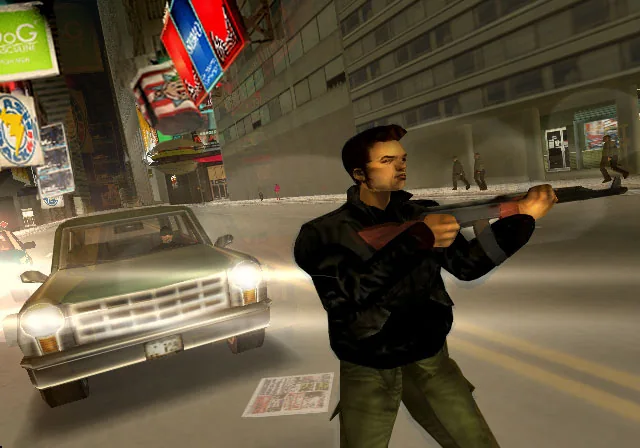
The move to PS2 placed the player inside Liberty City. The difference was not simply seeing familiar cars rendered with polygons. Camera, driving and movement on foot joined into a continuous experience: you recognised a corner, learned a shortcut and returned to a neighbourhood by choice. The map stopped being a representation viewed from outside and became a place you could know. Rockstar dates GTA III's original release to October 22, 2001. [G3]
GTA III did not invent free exploration. Its contribution was to combine driving, action, missions and urban simulation in a formula with enormous reach. In the developer recollections published by PlayStation for its twentieth anniversary, creators from Insomniac, Remedy and other studios describe how it changed their thinking about player freedom. That documented influence is more useful than giving one game absolute credit for inventing an entire genre. [5]
Take-Two's March 2008 presentation lists 14.5 million units, a historical milestone across platforms. [2] Our reading of its legacy is that it changed the commercial question: an action production could sell the feeling of living somewhere as well as a strong sequence of levels. Meeting that ambition demanded substantial work. Designers had to care about what happened between missions, accommodate unexpected solutions and keep systems entertaining when players stepped away from the script. A convincing city was not only a larger container for conventional tasks; it needed to support curiosity in its own right.
Vice City: atmosphere becomes the argument
A recognisable era and identity can matter as much as a larger map.
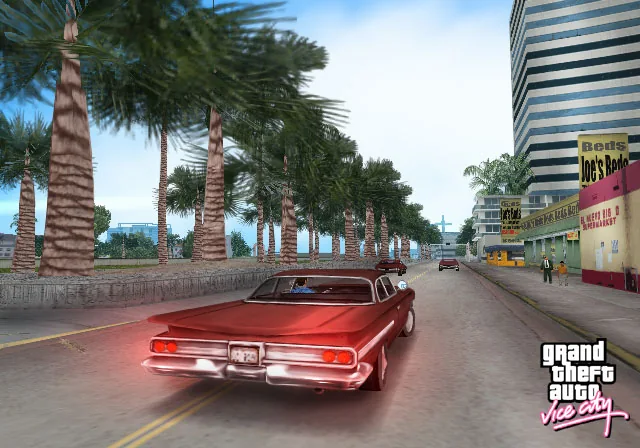
Released in October 2002, Vice City showed that personality could distinguish a sequel. Its reinterpretation of the 1980s connected architecture, clothing, colour, radio and criminal ambition. Tommy Vercetti gave the centre of the story a voice and a character. The result depended on more than what the streets allowed players to do: it mattered how travelling through them felt and what cultural references players recognised along the way. [G4]
Radio was especially effective because it accompanied a repeated activity: driving. It did not stop the game to establish a period; it blended into play. That integration helps explain why a song or the outline of a palm tree can become a memory of a session. From an editorial perspective, Vice City offers an answer to the habit of measuring open worlds in kilometres: a memorable space can distinguish itself through coherence before sheer size. Its journey through the city was also a journey through a carefully selected mood.
Take-Two put its sales at 17.5 million in March 2008, in the same document that provides context for GTA III and San Andreas. [2] Commercial growth accompanied an easily recognisable proposition, but that does not prove music or setting caused those sales. It does show the scale of the opportunity: GTA could sell an era, a tone and an entire fantasy. A critical reading should also ask whom its satire caricatures and which characters become accessories to the protagonist's story. A strong identity is worth analysing, rather than simply admiring.
San Andreas: from the neighbourhood to an entire state
The scale expands, while CJ's roots give the journey meaning.
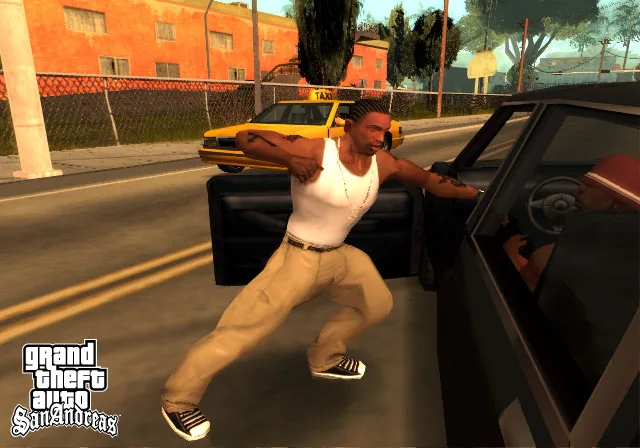
San Andreas arrived in October 2004 and stretched the journey across cities, highways, countryside and desert. Its ambition also reached the protagonist: clothes, physique and skills let the player's time leave a mark on CJ. The contrast between returning to the neighbourhood and discovering another region gave a much larger map an emotional structure. Variety mattered because it changed the pace: crossing a Los Santos street did not feel like driving away from the city. [G5]
A cultural reading needs to hold two ideas together. The story creates room for family loyalties, belonging, inequality and abuses of power; it also presents them through crime fiction that simplifies and exaggerates. Identifying with CJ does not require accepting every stereotype in the game. That tension belongs in a mature analysis: recognising the strength of its perspective without treating its representation as a complete explanation of life in the neighbourhoods that inspired it.
Take-Two's March 2008 document records a milestone of 21.5 million units. [2] Beyond that commercial reach, San Andreas left a specific institutional consequence. In 2006, the FTC announced a settlement concerning undisclosed sexual content that could be unlocked through modifications, the case known as Hot Coffee. The documented issue concerned disclosure and content ratings. It was not a finding that playing GTA caused crime. [6]
For the industry, the creative lesson was that ambition could encompass both a territory and the protagonist's daily life. The production lesson was that a game's content had to be considered beyond its ordinary playing route. Both belong to its legacy. Reducing San Andreas to controversy erases its design; reducing it to a nostalgic celebration leaves out the responsibilities that came with its expansion.
GTA IV: density instead of accumulation
A city's reactions can make it believable as effectively as its size.
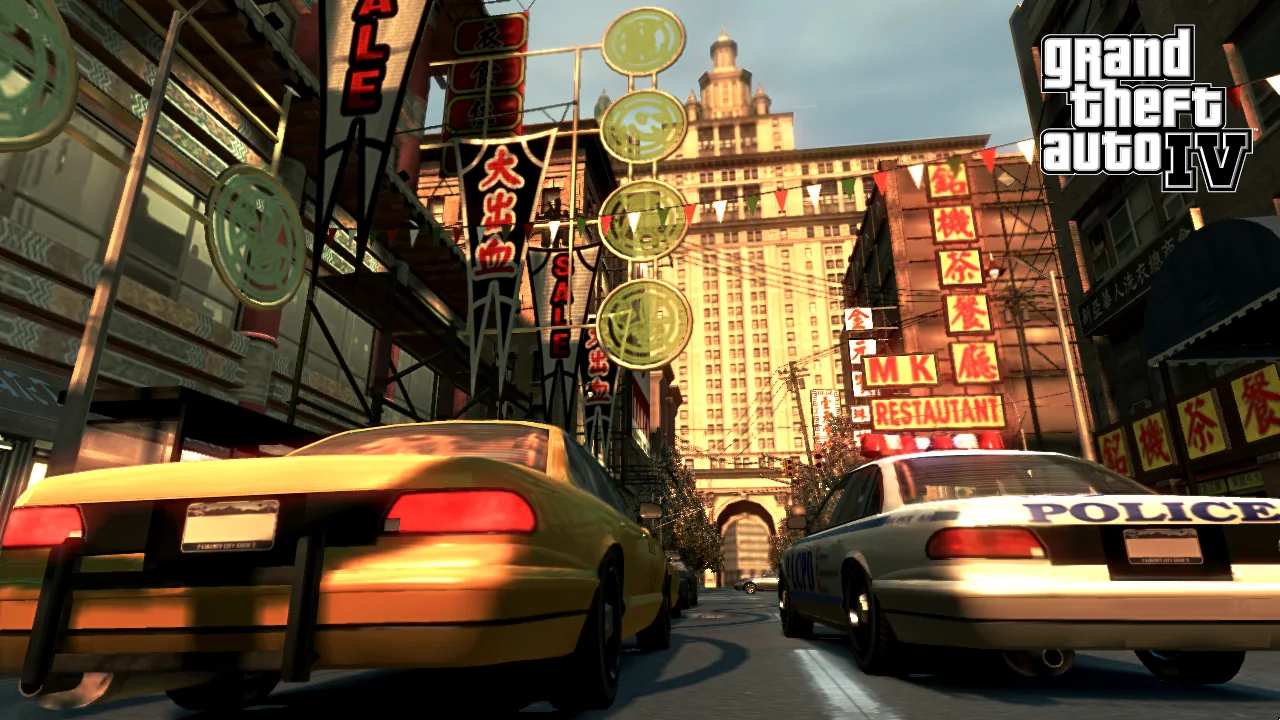
GTA IV launched on April 29, 2008 and returned to Liberty City with Niko Bellic. A new console generation allowed greater detail, but the game's identity also depended on the weight of driving, animation and interactions with other characters. Its story could be read as a bitter examination of promised prosperity: arriving somewhere new did not automatically free a person from old debts, relationships or violence. [G6]
Against San Andreas' appetite for accumulating activities, GTA IV invites us to value density. A conversation, a journey or a collision could reinforce the world's character without opening another area of the map. That does not make one philosophy superior. It helps explain why preferences between the two games can be so strong. Players seeking variety may miss options; those seeking coherence may find that fewer systems, more tightly connected to the tone, create a stronger sense of presence. Even an apparently ordinary drive can contribute to that impression.
Take-Two's 2013 documentation records more than 25 million units shipped and explicitly includes Complete and Special editions. These are not PS3-only sales. [3] In industrial terms, GTA IV embodies the move towards a production whose value depends on many small details working together. Our criterion for judging that transition is not a polygon count: it is how much of the city's character remains when we leave a mission and begin exploring without instructions. The ambition becomes less about offering everything and more about making what is there feel connected.
GTA V: three protagonists, three generations and a different economy
Success can no longer be measured only by the launch weekend.
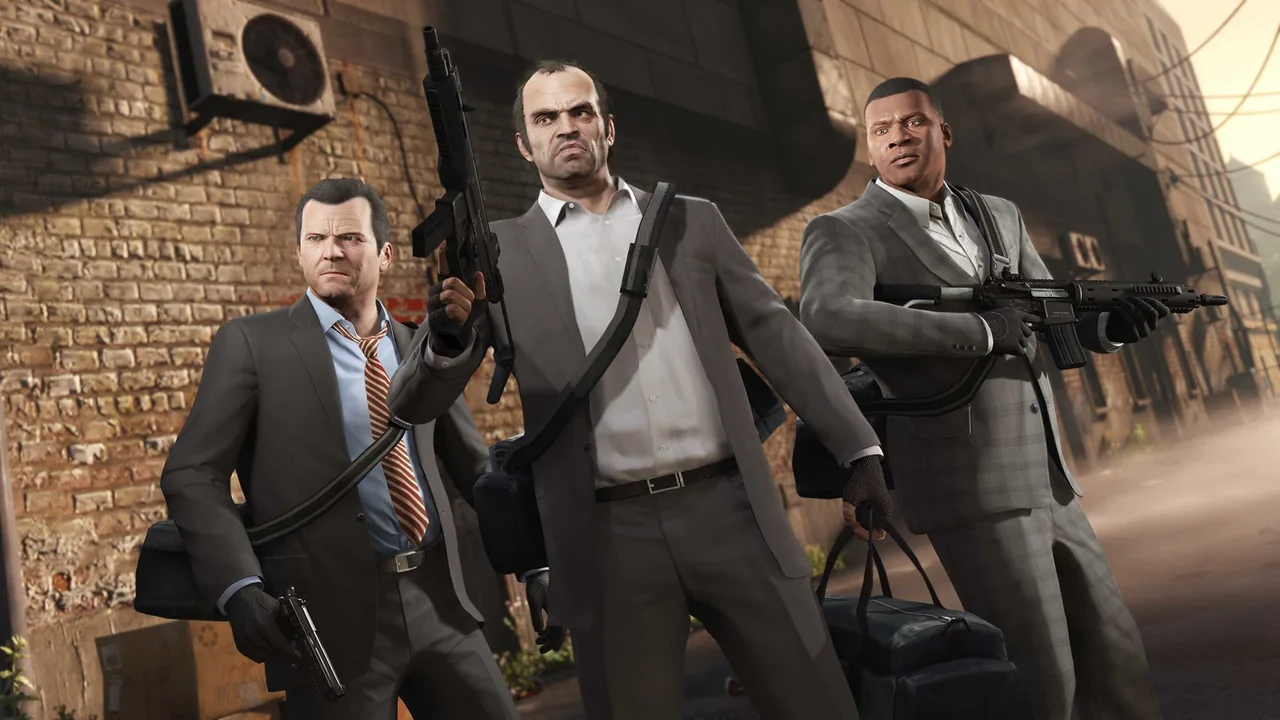
GTA V debuted on PS3 in 2013, reached PS4 in 2014 and arrived on PS5 on March 15, 2022. Michael, Franklin and Trevor let players alternate between social positions, tones and perspectives within one city. Switching characters also offered a narrative answer to the world's size: the player did not have to experience every transition through a single body. Heists organised a fantasy of planning and spectacle capable of bringing those trajectories together. [8] [9]
The PS5 version is not a new mainline instalment. It revisits an existing game through technical improvements and presentation choices. The official announcement describes modes prioritising quality or performance, faster loading and DualSense features. Precision matters here: resolution, ray tracing and frame-rate promises depend on the selected mode and should not be combined into a claim that every setting runs at its maximum simultaneously. [7]
Take-Two's August 2026 presentation puts GTA V above 230 million units shipped. This covers platforms and rereleases; it is neither a PS5 figure nor a count of unique people. [4] Its trajectory changes the unit of analysis. Asking how much it sold at launch is no longer sufficient. New audiences, purchases on newer platforms and sustained interest around GTA Online also matter. The campaign and the online world belong to the same phenomenon, but perform different roles.
GTA Online makes Los Santos a place to revisit with other people, to which new goals and content can be added. That changes the economics of time: an update can aim to retain as well as surprise. For players, continuity creates possibilities and community, but can also introduce obligation, comparison and routine. For a publisher, a lasting world opens recurring revenue opportunities; for players who prefer self-contained stories, the wait for a new campaign creates another scale of expectations. That tension is part of GTA V's success rather than an incidental footnote.
What changed in the games industry
The first transformation was in design. GTA helped make freedom between missions commercially central to action games. That legacy remains a demanding test: a map can contain hundreds of icons while offering little genuine initiative. The useful question is whether its systems let players solve, improvise or discover something beyond following a marker. Size gains meaning when it produces different situations. The challenge is to make a world worth exploring without treating every unplanned moment as an interruption.
The second was cultural. Radio, landscape, language and satire made the city recognisable beyond a particular session. Players could remember a neighbourhood as they remembered a film location, with the difference that they had made decisions inside it. That closeness explains both the potential for identification and the need to discuss caricature, representations of women, power and violence. Analysing a game does not require celebrating it without reservations or reducing it to a controversy.
The third was economic. GTA V shows how a work can cross console generations and operate as a campaign, a catalogue title and a meeting place at the same time. This does not mean every game should imitate the model. Sustaining a world for years needs content, support and a community; for many projects, a shorter, self-contained experience may be a better creative decision. GTA's influence does not turn its scale into a universal recipe.
What is worth asking of the next GTA
After this history, asking only for more kilometres or vehicles seems insufficient. The richer question is how space, characters and rules relate: whether a neighbourhood has personality on foot, whether traffic reactions can change a situation and whether the story retains its force after hours of freedom. These are criteria for examining a work, not predictions about features that have not been assessed here.
At GTA6Trucos, we follow that next chapter through our protagonist section, our look at Vice City and Leonida and our gameplay page. Comparing new material with the series' history helps distinguish a visible improvement from a deeper transformation. GTA's most lasting legacy is that expectation: a game city should offer something we want to make our own, as well as something worth looking at.
Sources and methodology
This is GTA6Trucos editorial analysis. Interpretations of design and culture are distinguished from documented figures. Sources were checked on September 22, 2026; each data cutoff is retained and does not change merely because the article is reviewed.
The bars show selected documented milestones, not necessarily the latest known total for each game. GTA III, Vice City and San Andreas share a March 2008 cutoff. The 2013 GTA IV document includes Complete and Special editions; GTA V uses August 2026. We do not add later sales or rerelease estimates to older milestones.
GTA 2 uses shipments reported during its release fiscal year; the original GTA has only a fiscal-period figure here and is kept separate from the cumulative chart. Sold-in and shipped refer to units supplied to the channel, not necessarily final consumer purchases. The 2008 presentation calls its figures units sold. We do not turn differing metrics into a level of precision the sources do not support.
All figures retain their sources’ scope: they are not a PlayStation-only breakdown. Nor do they measure unique users, revenue or profitability. Repeat purchases and different periods of availability mean dividing one bar by another does not measure audience growth.
The timeline places games and versions within their console generations. Early releases varied by territory and platform; we do not assign one worldwide release date to the original GTA or GTA 2. Official screenshots illustrate each work but do not certify their capture platform unless explicitly stated. Credits are retained; the images are not presented as our own or as openly licensed.
- Take-Two · Form 10-K, FY1999 · Releases, p. 4
- Take-Two · Investor presentation, March 2008 · slide 12 (SEC archive)
- Take-Two · Investor presentation, 2013 · Grand Theft Auto franchise
- Take-Two · Q1 FY2027, August 2026 · slide 11
- PlayStation.Blog · GTA III turns 20 · November 2, 2021
- FTC · Makers of GTA: San Andreas Settle FTC Charges · June 8, 2006
- Rockstar / PlayStation.Blog · GTAV and GTA Online coming to PS5 · March 4, 2022
- Rockstar · Grand Theft Auto V Is Coming 9.17.2013
- Rockstar · GTA V release dates for PS4 and Xbox One · September 12, 2014
Official game pages and images
- [G1] Grand Theft Auto — official page / media
- [G2] GTA 2 — official page / media
- [G3] GTA III — official page / media
- [G4] Vice City — official page / media
- [G5] San Andreas — official page / media
- [G6] GTA IV — official page / media
- [G7] GTA V — official page / media
Text, editorial selection and chart: GTA6Trucos. Game images: © Rockstar Games and their respective owners. Independent fan site, not affiliated with Rockstar Games, Take-Two or Sony.
Questions about the data
Are these PlayStation sales?
No. The figures retain the platform or period scope of the original documents. PS1–PS5 is the historical thread, not a sales filter.
Is GTA V on PS5 a separate mainline game?
No. It is a version of GTA V, originally released in 2013. The cited commercial total does not refer only to the PS5 edition.
Why include older figures?
A dated, verifiable figure is more useful than a total without a clear origin. The 2008 and 2013 milestones are not presented as 2026 totals.